
Vibe Coding to Production: What Breaks and How to Fix It
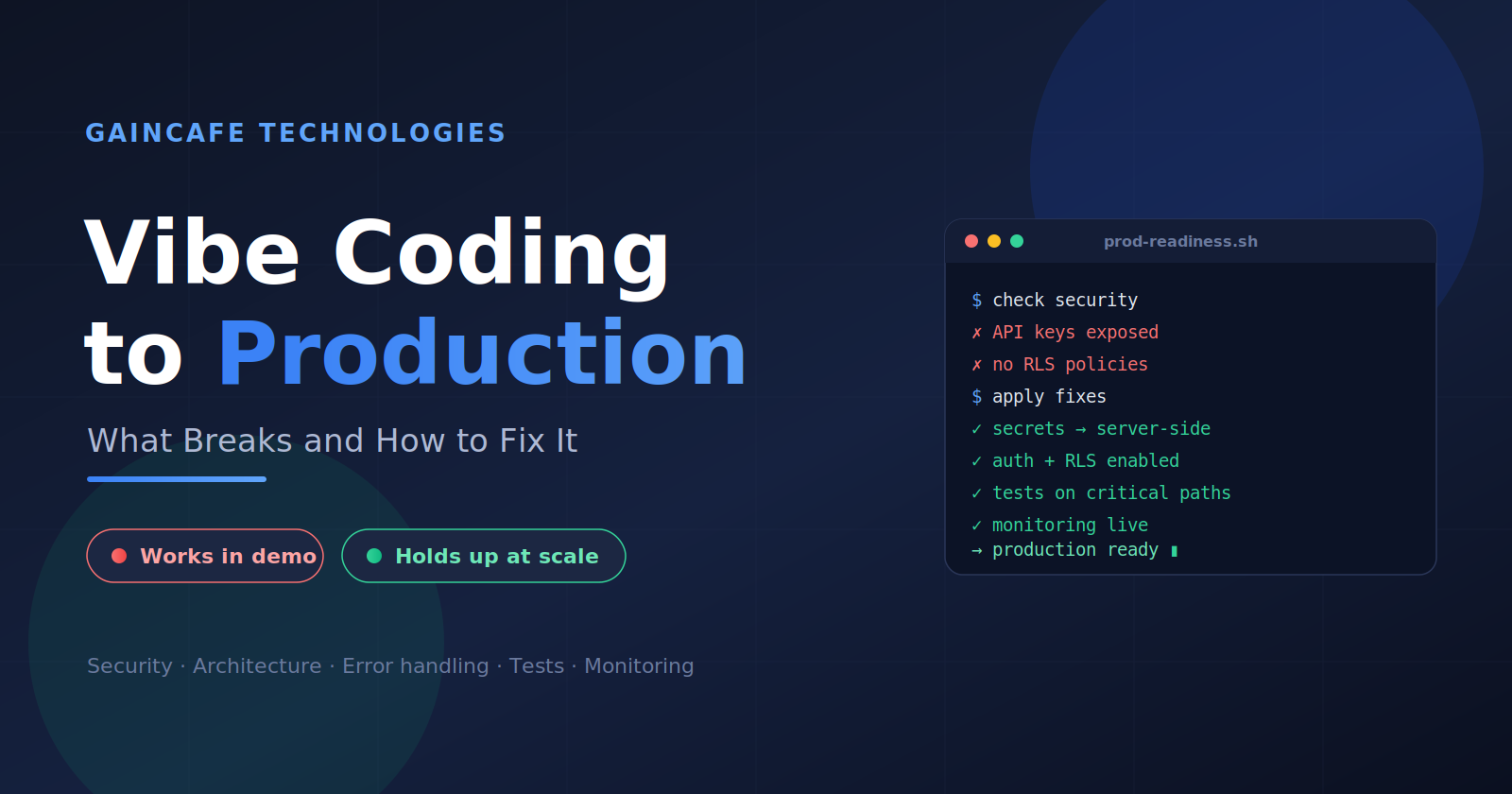
Vibe coding is genuinely great at getting you to a working app. You describe what you want, the AI writes it, and in a weekend you have something that runs. The problem starts the moment real users show up. The demo that worked beautifully on your machine begins leaking data, slowing down, and throwing errors nobody can trace. This is the gap nobody warns you about: the distance between "it works" and "it holds up in production" is where most vibe-coded apps quietly fall apart. Here is exactly what breaks, and how to fix each one.
I am writing this as a developer who has shipped and hardened a lot of AI-assisted code, the kind of AI development and automation work where fast prototypes have to become reliable products. None of this is a reason to stop vibe coding. It is a checklist for turning a fast prototype into something you can actually run.
1. Security: The Thing AI Skips by Default
This is the big one. AI models optimize for "make it work," not "make it safe," so vibe-coded apps routinely ship with real vulnerabilities the model never flagged.
The usual suspects:
- Exposed API keys hardcoded in the frontend or committed to the repo.
- Missing authorization checks, where any logged-in user can hit any endpoint or read any row.
- No input validation, leaving you open to injection and malformed-data crashes.
- Over-permissive database rules, especially with tools that default to open access during prototyping.
The fix: move every secret to server-side environment variables, add real authentication and authorization on the backend (never trust the client), validate and sanitize every input, and lock down your database with row-level security so each user can only touch their own data. If you are on Supabase, write explicit RLS policies and test them with a non-admin user before you launch.
2. Architecture That Cannot Scale
AI tends to generate code that works for one user and collapses at a thousand. It will cheerfully write a query that runs on every render, store everything in one giant table, or block the main thread with synchronous calls, because none of that shows up in a demo.
The fix: review the data model before you build on it, add database indexes on the columns you actually query, move heavy or slow work into background jobs and queues, and cache the reads that get hit constantly. You do not need microservices on day one. You do need a clean, indexed schema and an app that does not re-fetch the world on every click.
3. No Error Handling (Everything Is a Happy Path)
Vibe-coded apps are written for the case where everything goes right. The API always responds, the user always fills the form correctly, the network never drops. Production is the opposite: things fail constantly, and an app with no error handling just shows a white screen or crashes.
The fix: wrap external calls in try/catch, handle loading and error states in the UI, add retries with backoff for flaky network calls, and return clear, non-leaky error messages. Add a basic error-tracking tool so you find out about failures before your users tell you.
4. Zero Tests, So Every Change Is a Gamble
AI rarely writes meaningful tests unless you explicitly ask, so most vibe-coded apps have none. That is fine until you change one thing and silently break three others, with no way to know until a user hits it.
The fix: you do not need 100% coverage. Write tests for the handful of flows that would hurt most if they broke: authentication, payments, and your core user action. Even a thin layer of integration tests on the critical paths turns every future change from a gamble into a safe edit. If you are weighing whether to keep building solo or bring in help at this point, this honest comparison of AI app builders vs hiring a developer is worth a read.
5. The Database Is a Time Bomb
This deserves its own point because it is where the most expensive failures live. AI-generated schemas are often naive: no foreign-key constraints, no indexes, inconsistent types, and no migration strategy. It works with ten rows and falls over at ten thousand.
The fix: normalize the schema where it matters, add constraints and indexes, pick a migration tool and use it from now on so schema changes are versioned, and never edit production data by hand. If the AI built your schema in a hurry, a one-time cleanup here saves you from the rewrite later.
6. Secrets, Config, and Environments Are a Mess
Prototypes tend to hardcode everything and run in one environment. Production needs separation: local, staging, and production, each with its own config and secrets, and nothing sensitive in the repo.
The fix: move config into environment variables, set up a staging environment that mirrors production, and use a secrets manager rather than a committed .env file. This is boring and it is also the difference between a controlled deploy and a 2 a.m. incident.
7. No Monitoring, So You Are Flying Blind
A prototype has no logging, no metrics, and no alerts. In production that means you find out something is broken when a customer emails you, which is the worst possible monitoring system.
The fix: add structured logging, basic uptime and performance monitoring, and alerts on errors and latency spikes. For an AI app, also watch your token usage and cost, because a runaway loop or a popular feature can quietly multiply your bill overnight.
A Practical Pre-Launch Checklist
Before you put a vibe-coded app in front of real users, run through this:
- Secrets are server-side, nothing sensitive in the repo.
- Real auth and authorization on every protected endpoint.
- Database has row-level security, constraints, and indexes.
- External calls have error handling and sensible fallbacks.
- Tests cover auth, payments, and your core flow.
- Staging environment exists and mirrors production.
- Logging, monitoring, and cost alerts are live.
If you can tick all seven, you have crossed the real gap, from a thing that runs to a thing that holds up.
The Honest Takeaway
Vibe coding is a genuine superpower for the first 80% of a build. The last 20%, the security, the architecture, the error handling, and the tests, is still engineering work, and it is the part that decides whether your app survives contact with real users.
If you are staring at a prototype that needs this treatment, here is a practical, step-by-step guide to taking a vibe-coded app to production-ready. The fastest teams use AI to move quickly, then bring real engineering discipline to the production step rather than shipping the prototype as-is.
Build fast, then build it right. That is the whole game.
About the author
- Lakshya Pareek is the Digital Marketing Manager at Gaincafe Technologies, an India-based custom software and AI development company helping startups and enterprises build smarter digital products.
Comments
Join the discussionNo comments yet. Be the first to comment.
